
From first look to a recorded decision.
Move deals through stages your firm defines, bring them to committee, and keep the vote, the memo and the reasoning in one record you can find again.
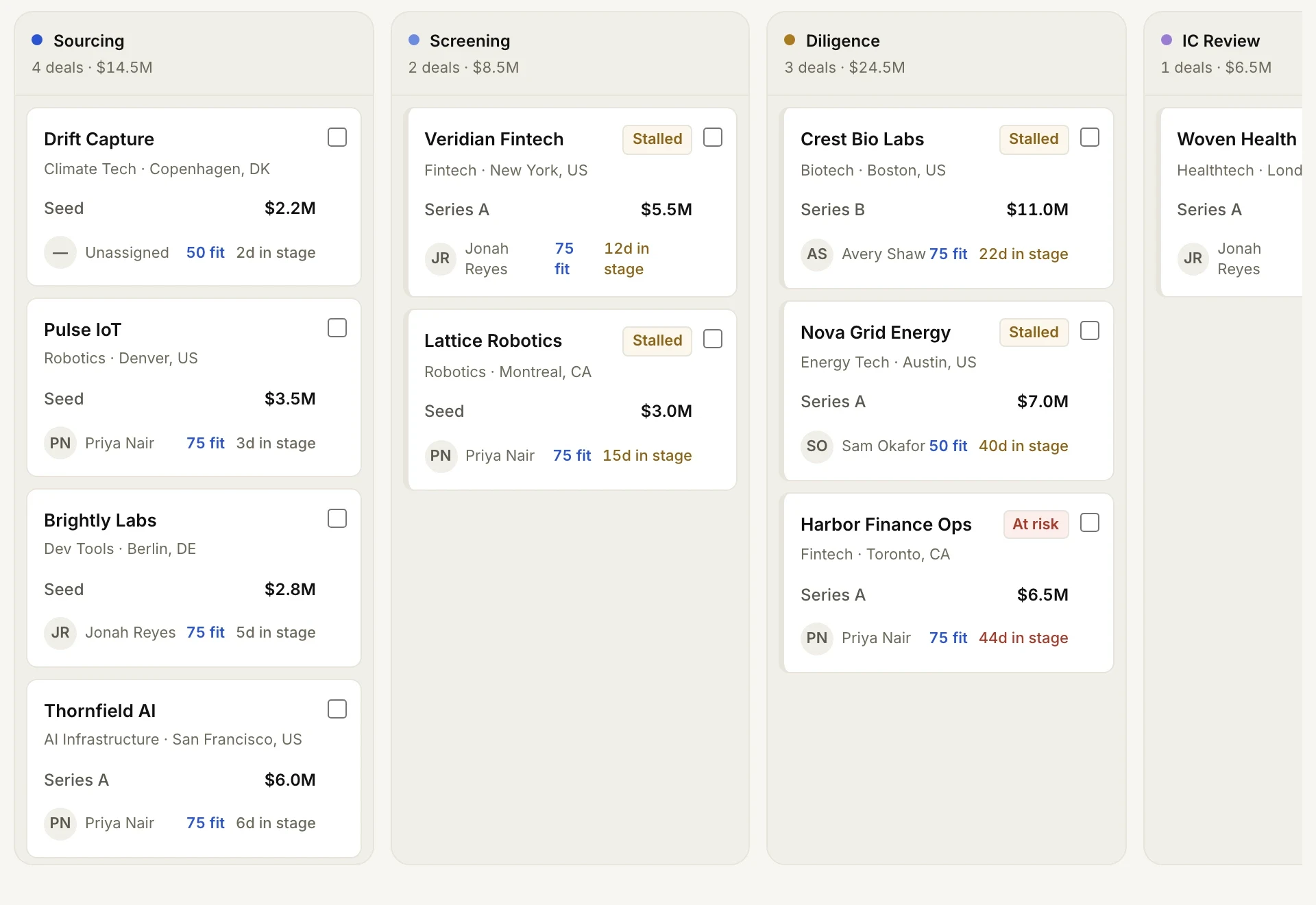
A pipeline that fits how you work
Board, list and timeline views. Stages are yours to define. Each deal shows its owner, round, ask, thesis fit and how long it has sat in a stage, and flags deals that have stalled or are at risk. Import from CSV to start.
Committee, on the record
Build agendas, run IC sessions, collect votes and record the decision with its reasoning. Committee rules are set once for the firm, and the session view warns you when an agenda is too long for the time you have.
A memo you can read as a document
Write the investment memo section by section, then switch to a preview that shows it exactly as the committee will read it, from what you have typed, and open a printable page of the saved version.
Rules that act for you
Write workflow rules that fire when a deal changes stage, so the follow-up tasks and notifications happen without someone remembering to create them.
An unknowns list that cannot be skipped.
Write down each open question on a deal, with how much it matters, which decision depends on it and who owns it. A question closes only with a sourced answer, or with a written reason to accept the risk. The committee checklist stays blocked while a blocking question is open, and says “no questions recorded” when nothing has been written down, instead of implying nothing is unknown.
Follow-through that cannot be skipped.
Choose which kinds of task need a written note before they can be completed: compliance, signatures, approvals or others. The person who raised an approval cannot be the one who gives it, once your team has two people. A diligence item cannot be marked blocked without saying what is blocking it. Before you archive a deal, you see which open tasks will be closed and what will be left open. Every change to a workflow rule is kept, and editing a rule never changes the tasks it already created. These rules are enforced by the system itself, so no screen or import can skip them.
On the Institutional plan, set an automatic escalation after a number of days, and anything overdue is marked as escalated for the whole team. It sends no message and creates no tasks. Everything else in this section is in every plan.
Learn from how decisions played out.
Set a target on a memo, then review how the decision compared with your own expectations later. Decision quality, replay and a time-machine view are built on your own records, not an outside benchmark.
A pipeline forecast weights open deals by stage probability once you have set them.
Deal flow and IC, answered.
Can I define my own pipeline stages?
Yes. Pipeline stages are configured per firm in settings, and deals move through the stages you set.
Can I import deals I already track?
Yes. You can import deals from a CSV file, and export your pipeline to CSV at any time.
Does VentureFract find deals for me?
No. It is where you manage the deals you already source. We do not match investors with founders or broker introductions.
Run your pipeline here.
Create your firm and bring your own deals. No payment is needed to start.